










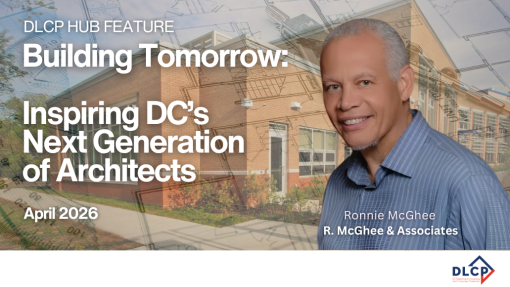
Architecture Month is a time to honor the designers who shape the spaces where we live, work, and connect. And in Washington, DC, chances are you’ve already been touched by the work of Ronnie McGhee—whether you’ve walked through a building he restored, visited a landmark he helped preserve, or experienced a space designed by one of the many architects he has taught and mentored over the years.
Ronnie McGhee is a Washington, DC–based architect with more than three decades of expertise in new construction, building rehabilitation, and historic restoration, has left an imprint on the city’s architectural fabric as well as the people who will carry it into the future. His portfolio includes works like the historic, award-winning Whitelaw Hotel Apartments, a pivotal African American landmark listed on the National Register of Historic Places.
McGhee’s passion began in the neighborhood where he grew up—River Terrace, near DC’s Anacostia River. “I was outside all day making things,” he recalls. “I never liked Legos because they felt too easy. I wanted to make things from scratch.” That curiosity eventually pulled him from anthropology studies at Northwestern University to Howard University, where he earned his Bachelor of Architecture and later returned as an associate professor. Teaching clarified his purpose.
For McGhee, Architecture Month is both celebration and civic education. “It’s important to have architecture in focus—like Women’s History Month or Black History Month—because most people go through life never knowing what architects do,” he says. “Outreach to kids highlights what architects have done here, and how design affects daily life.”

McGhee also shared with us his thoughts around the limits and responsibilities of design. Midcentury thinking once claimed architecture could “solve” social problems; experience proved otherwise. “You can’t solve social problems with architecture—but you can certainly make them worse with bad architecture or bad planning.” He brings a human-scaled focus to public projects, including family shelters. “Many individuals who come into these spaces are coming out of trauma, and you have to make that transition as easy as possible,” he says. “Making the architecture part of the solution is something you want to highlight in a month like this.”
As a former member of DC’s Historic Preservation Review Board, McGhee is known for balancing contemporary design with historic context. “Modern buildings can fit within historic districts as long as you respect the guidelines,” he explains. “The review process gives the public a voice, which gives communities more control over their neighborhoods.”
In DC, he adds, human-scaled streets, trees, and materials are part of the city’s identity—and its appeal. He recalls the Duke Ellington Building stepped down in height and tuned its materials to meet lower scale neighbors across the street, “so it looks like it’s part of the neighborhood—the context.”
McGhee challenges architects to “come in with something wonderful that will be historic in 50 years. Do something in 2026 that in 2076 we will want to preserve.”

McGhee currently serves as Chairman of the DC Board of Architecture, Interior Design, and Landscape Architecture, helping guide standards of practice and the city’s evolving built environment, and is a member of the National Council of Architectural Registration Boards (NCARB) Board—commitments that reflect his belief that good governance and good design go hand in hand.
His legacy is equally defined by service, inclusivity, and mentorship. Over the years at Howard and in practice, he has guided hundreds of architectural students. RMc also mirrors the global nature of architecture today. “We’ve had 20–25 nationalities here over the years,” McGhee notes. “Interns and staff have come from Sudan, Iran, Trinidad, Ethiopia, Russia, and elsewhere. Diversity exposes us to new ways of thinking about space, color, form, and design—and in the end, it strengthens our work.”
On AI in practice, McGhee is both openminded and cleareyed. “It’s like the ocean tide coming in,” he says—vast, inevitable, and full of possibility. But he cautions that foundational understanding must keep pace. “You can make a building look real on a computer and not know how it’s put together. Schools and firms will need to ensure people still learn how things work.”
His advice to emerging architects is simple: be a lifelong learner. “Wonder about the environment. Ask how things work. Imagine what isn’t there yet—and then make it.”

McGhee gravitates to projects with ripple effects that shape how people live and learn. “I’ve pursued big projects, even stadium work, but the ones that matter most are the ones that create long term impact.”
That impact is also personal. At an American Institute of Architects (AIA) convention years ago, where he was being honored, he kept bumping into former students—now licensed architects, firm leaders, educators. The moment crystallized his contribution: building not only structures, but careers and communities.
As the District continues to evolve, Ronnie McGhee’s work offers a compelling model of community centered architecture, technically sound, historically informed, and deeply human. This Architecture Month, we celebrate his passion, curiosity, and the doors he opens for others.